
Associate Dentist Tax Return UK: Self Assessment Checklist

Most associate dentists do not struggle with tax because they cannot understand the final tax form. They struggle because the records are scattered: practice statements in one place, lab bills in another, receipts in WhatsApp, mileage notes in a camera roll, and a few "I will remember that later" costs that nobody remembers later.
That is the job Associate Finances should solve. Not by pretending to be an accountant. Not by promising a final tax answer. By helping the dentist keep cleaner records through the year and build a review pack that is much easier to check.
Can an associate dentist do their own tax return?
Some can, especially where the year is simple and the dentist is comfortable with Self Assessment. Many will still prefer an accountant, particularly if they have mixed income, partnership income, property income, student loan questions, pension questions, maternity or parental leave effects, or anything unusual.
The safer target is this: help dentists do as much of the preparation themselves as possible, while making the final responsibility clear.
Good software should help with:
- income records for NHS, private, day-rate, and manual adjustments
- lab costs and other deductions
- expenses and receipts
- notes for anything that needs accountant review
- a printable report for manual checking
- a CSV export for an accountant or spreadsheet backup
- AI prompts that spot gaps without giving tax advice
The UK dates that matter
For UK Self Assessment, the tax year runs from 6 April to 5 April. HMRC publishes the current filing and payment deadlines on GOV.UK, including online filing and payment dates. Always check the current official deadline before relying on memory.
Useful source: HMRC Self Assessment deadlines.
This is why a normal calendar-year dashboard is not enough for UK associates. A dentist needs a tax-year view, not just a month-by-month income chart.
What records should an associate dentist keep?
HMRC guidance for self-employed records includes business income, business expenses, and receipts or other proof. For associate dentists, that usually means building a pack like this:
- associate income statements from each practice
- private income summaries
- NHS or UDA-related summaries where relevant
- lab invoices and lab-share deductions
- indemnity, professional subscription, and course records
- equipment, materials, loupes, uniform, and other business purchases
- travel and mileage evidence where relevant
- bank or card records that support business costs
- notes explaining any mixed-use or unusual item
Useful source: HMRC self-employed records guidance.
Expenses: organise evidence first
HMRC says self-employed people can deduct allowable business costs when working out taxable profit, but not personal costs. The important product principle is that software should help organise and evidence expenses, not declare that every item is definitely allowable.
Useful source: HMRC allowable expenses guidance.
That means each expense record should ideally have:
- date
- supplier
- amount
- category
- receipt or evidence
- short note if the item might need explaining
- review status
This is exactly where a printable pack helps. A dentist can sit down once, scan the report, mark questions, and send only the doubtful items to an accountant.
Where AI helps
AI is useful when it acts like a careful checklist assistant.
It can ask:
- Are there income months with no practice statement attached?
- Are there large expenses with no receipt?
- Are there lab costs that do not match the expected associate split?
- Are there personal-looking items in a business expense category?
- Are there costs that probably need an accountant note?
- Are there records outside the selected tax year?
That is valuable. It saves time and reduces the chance of missing obvious gaps.
Where AI should not help
AI should not tell a dentist:
- this expense is definitely allowable
- this is your final taxable profit
- this is your final tax bill
- your return is correct
- submit this without review
That is how a helpful finance tool becomes risky. The safer wording is: "This is a preparation checklist. Review the records yourself and ask HMRC or an accountant if unsure."
Making Tax Digital readiness
Making Tax Digital for Income Tax is being phased in for some self-employed people and landlords. GOV.UK says it applies from April 2026 for qualifying income over GBP 50,000, then lower thresholds follow in later years.
Useful source: GOV.UK Making Tax Digital for Income Tax.
Associate Finances should not claim direct HMRC submission unless that integration exists. But it can still help dentists move in the right direction by keeping digital income and expense records in a cleaner structure.
A practical Self Assessment prep checklist
Before filing or sending records to an accountant, an associate dentist should be able to answer:
- Have I included every practice I worked at during the tax year?
- Do my income totals match the statements I received?
- Have I separated expenses from lab deductions?
- Do I have receipts or evidence for business costs?
- Have I marked anything that needs accountant review?
- Have I checked the tax year is 6 April to 5 April?
- Have I exported or printed a copy of the final pack?
How Dentistry Dashboard helps
Associate Finances is designed to make that preparation much easier for dentists. It brings together income, expenses, lab costs, printable tax-prep packs, accountant CSV exports, and AI checklist prompts inside the same Dentist Zone workspace as AI Notes.
It is not tax advice. It does not replace HMRC, an accountant, or your own review. It gives you a cleaner starting point, which is often the difference between a stressful January and a calm one.
The bottom line
Yes, this can help associate dentists do much more themselves. The winning version is not "AI files your tax return". The winning version is "your records are organised, checkable, printable, and exportable - with AI helping you spot what needs a second look."
That is useful to dentists. It is useful to accountants. And it keeps the responsibility in the right place.
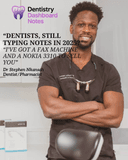
About Dr Stephen Nkansah
UK-registered dentist (GDC) and founder of Dentistry Dashboard. Built the platform after experiencing first-hand the documentation burden of UK dental practice — the AI Notes, voice perio charting, and bundled clinical workspace are the tools he wished he’d had as an associate.
Read the founder story →Related Articles
Palmer Notation Chart: Tooth Numbers, Symbols & Printable Guide
Read Palmer tooth notation with a complete adult and primary teeth chart, quadrant symbols, FDI comparisons and a free printable reference.
Read more →UK Dental Charting Symbols Cheat Sheet (2026) + Free PDF
Every UK dental charting symbol on one page: surfaces, restoration materials, tooth status, BPE codes, mobility and furcation. Free printable A4 PDF, no sign-up.
Read more →BSP Staging and Grading Cheat Sheet (2026) + Free Calculator
Stage I-IV, Grade A-C, plaque and bleeding scores, engagement and stability from the BSP 2017 classification on one page, with worked examples and a free calculator.
Read more →